 K-Dogam
No. 002 · Jjigae
Doenjang Jjigae Recipe (Basic Korean Soybean Paste Stew)
된장찌개 · Doenjang-jjigae
Servings & Time
2 servings · Prep 15min · Cook 20min
About This Dish
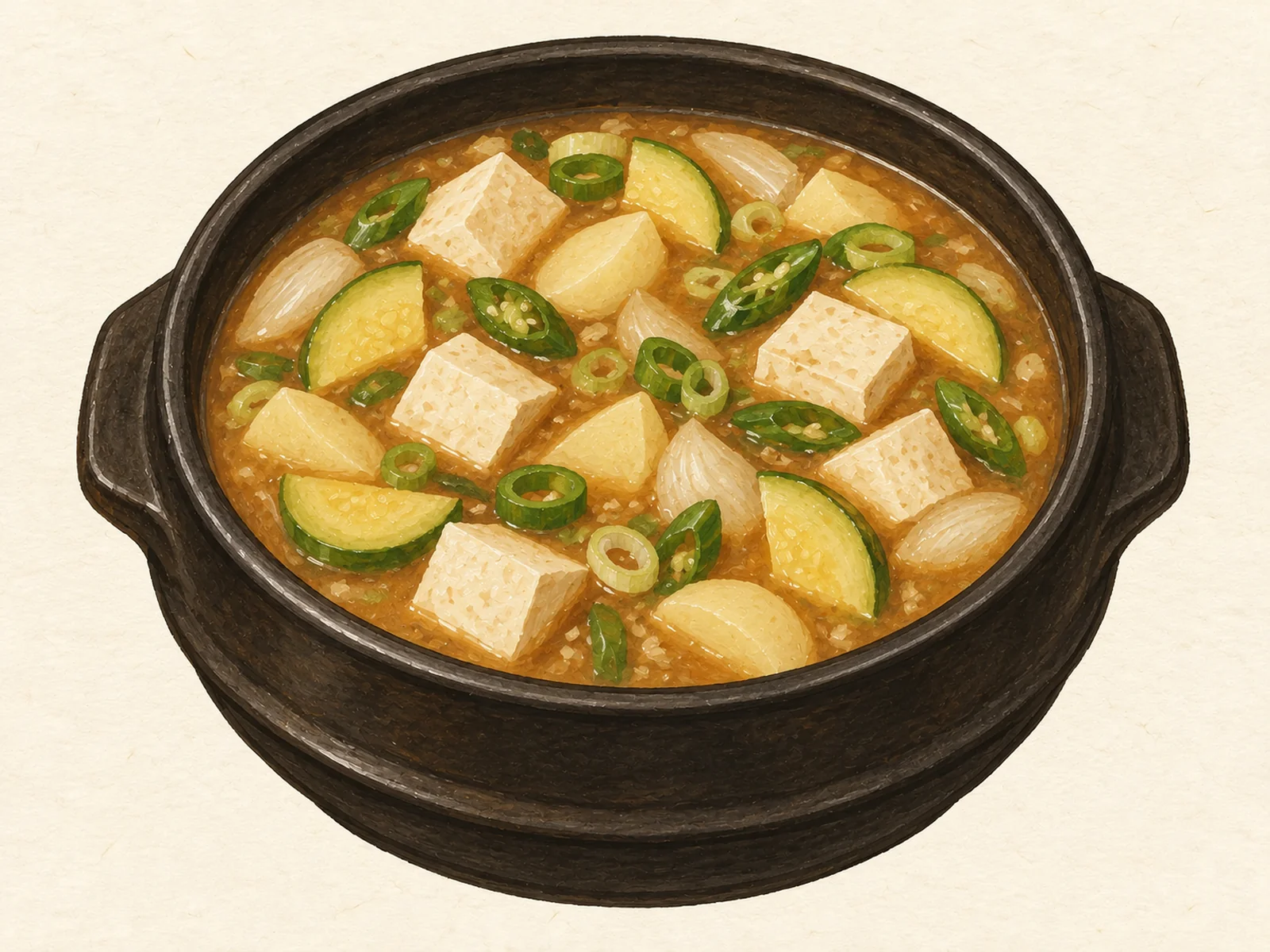
This basic doenjang jjigae serves two in about 35 minutes. Korean soybean paste is dissolved in anchovy stock and simmered with potato, onion, aehobak (Korean summer squash) and tofu. The key is the paste itself: brands differ in saltiness, so it goes in a little at a time.
Doenjang jjigae is a Korean stew seasoned with doenjang (Korean soybean paste). In this basic version, vegetables and tofu simmer in anchovy stock, the deep, savory flavor of the doenjang carries the broth, and the vegetables add sweetness as they soften.
Siuijeonseo, a cookbook whose original is thought to have been compiled in the late 19th century, records jochi, dishes that correspond to today’s jjigae (stew). A 1920 essay in the magazine Gaebyeok describes a rural breakfast table with doenjang jjigae beside yeolmu kimchi (young radish kimchi) and braised green chili peppers.
Ingredients
Scroll sideways to see all columns →
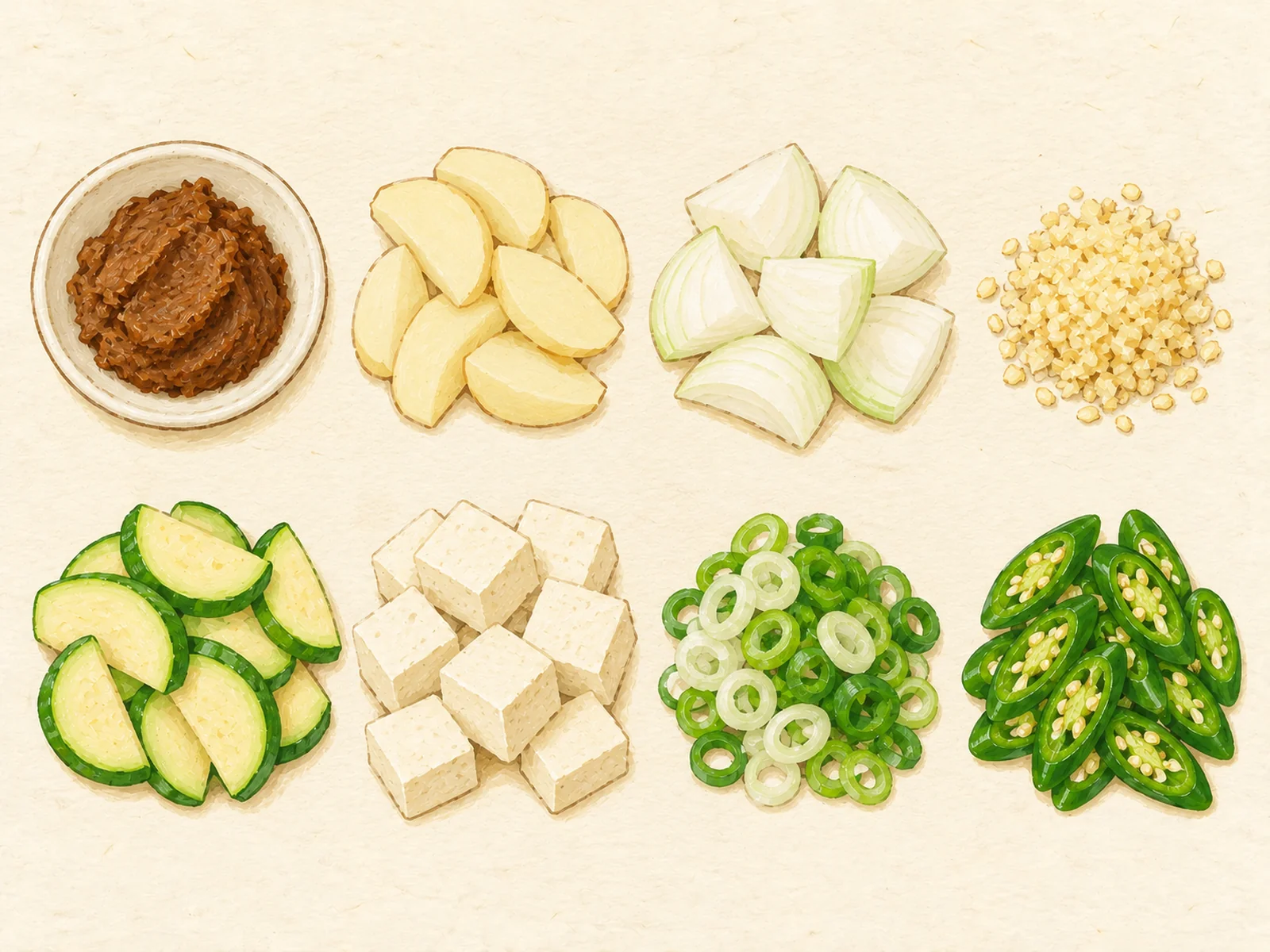
| # | Ingredients | Qty | Remarks |
|---|---|---|---|
| 01 | Anchovy stock | 500 ml (about 2 cups) | Use prepared stock. Keep up to 50 ml (about 3 1/3 tbsp) water for seasoning. Making stock and cooking rice are not included in the 35-min total |
| 02 | Doenjang (Korean soybean paste) | 2 tbsp (30 ml) | Saltiness varies by product. Start with 1 1/2 tbsp |
| 03 | Potato | 1/2 ea (about 80 g / 2.8 oz) | 0.6 cm (about 1/4 in) half-moons |
| 04 | Onion | 1/4 ea (about 50 g / 1.8 oz) | 2 cm (about 3/4 in) pieces |
| 05 | Minced garlic | 1 tsp | |
| 06 | Aehobak (Korean summer squash) | 1/3 ea (about 100 g / 3.5 oz) | 1 cm (about 3/8 in) half-moons. Alt: zucchini |
| 07 | Medium-firm or firm tofu | 150 g (5.3 oz) | Cut into 1.5 cm (about 5/8 in) cubes |
| 08 | Green onion | 1/2 stalk | Thin rings |
| 09 | Cheongyang chili (Korean hot green chili) | 1 ea (optional) | Thin diagonal slices. Omit for a mild stew. Alt: any hot green chili |
Equipment
- Pot, 18–20 cm (about 7 1/8–7 7/8 in), or ttukbaegi (earthenware pot)
- Fine strainer or ladle, for dissolving doenjang
- Fork, for the potato check
Instructions
Cut the potato, onion, aehobak, tofu, green onion and chili (if used) as noted in the ingredients.
Potato 1/2 ea (about 80 g / 2.8 oz) · Onion 1/4 ea (about 50 g / 1.8 oz) · Aehobak (Korean summer squash) 1/3 ea (about 100 g / 3.5 oz) · Medium-firm or firm tofu 150 g (5.3 oz) · Green onion 1/2 stalk · Cheongyang chili (Korean hot green chili) 1 ea (optional)
Pour the anchovy stock into the pot. Dissolve 1 1/2 tbsp doenjang until no lumps remain.
Anchovy stock 500 ml (about 2 cups) · Doenjang (Korean soybean paste) 1 1/2 tbsp
Add the potato. Bring the stock to a boil over high heat.
Potato 1/2 ea (about 80 g / 2.8 oz)
Reduce the heat to medium. Simmer for about 5 min.
Add the onion and garlic. Simmer for about 3 min until a fork enters the potato center easily.
Onion 1/4 ea (about 50 g / 1.8 oz) · Minced garlic 1 tsp
Add the aehobak. Simmer for about 3 min until the aehobak is tender but keeps its shape.
Aehobak (Korean summer squash) 1/3 ea (about 100 g / 3.5 oz)
Taste the broth. If the broth is bland, dissolve up to 1/2 tbsp more doenjang. If it is too salty, add up to 50 ml (about 3 1/3 tbsp) water in small amounts.
Doenjang (Korean soybean paste) up to 1/2 tbsp
Add the tofu. Simmer for about 2–3 min until the tofu centers are hot.
Medium-firm or firm tofu 150 g (5.3 oz)
Add the green onion and the chili, if used. Turn off the heat. Serve with rice.
Green onion 1/2 stalk · Cheongyang chili (Korean hot green chili) 1 ea (optional)
Doneness Check
- Broth is opaque brown with no doenjang lumps
- A fork enters the center of the potato easily
- Aehobak is tender but keeps its shape
- Tofu cubes are hot through and intact
Variations
- Chadolbagi doenjang jjigae
- Thin fatty beef brisket goes in late, together with the tofu.
- Pork doenjang jjigae
- Pork starts in cold water, so no separate stock is made.
- Clam doenjang jjigae
- Clams are boiled first and lifted out, the broth is strained, and the clams return at the end.
Similar Dishes
- Cheonggukjang jjigae
- Cheonggukjang jjigae uses cheonggukjang (short-fermented soybeans), which has a stronger fermentation smell than doenjang.
- Doenjang guk
- Doenjang guk is a broth-focused doenjang soup whose thickness and heat vary by recipe.
FAQ
Can I make it without anchovy stock?
Yes. Plain water works because the doenjang carries most of the flavor, and water from rinsing rice adds body. Check the doenjang label too: some products contain anchovy extract.
Why does my stew taste saltier or milder than expected?
Doenjang saltiness varies widely by product and batch. That is why this procedure starts with 1 1/2 tbsp and adjusts at the tasting step instead of adding the full amount at once.
Can I add meat or seafood?
Some versions add thinly sliced fatty beef or clams, but they change the order of steps and add their own doneness checks. This procedure covers the basic version only.
Where can I buy doenjang?
Korean grocery stores and online Korean food shops carry it, usually in tubs labeled doenjang or Korean soybean paste. Other countries' fermented soybean pastes differ in taste and saltiness, so they are not a one-to-one swap.
Sources
- Maangchi — Doenjang-jjigae
- Korean Bapsang — Doenjang Jjigae
- My Korean Kitchen — Doenjang Jjigae
- Carmy — Doenjang Jjigae
- 10000recipe — Chadolbagi doenjang jjigae (Korean)
- Kim Jin-ok — Basic doenjang jjigae (Korean)
- Wtable — Doenjang jjigae (Korean)
- Doenjang salinity study (PMC, 2023)
- Sempio — Doenjang ingredients
- Bon Appétit — How to boil potatoes
- FoodSafety.gov — Cold food storage chart
- 10000recipe — Pork doenjang jjigae (Korean)
- 10000recipe — Clam doenjang jjigae (Korean)
- Seoul Shinmun — Cheonggukjang and doenjang fermentation (Korean)
- Better Korean — Differences between jjigae, guk and tang
- Maangchi — Baechu doenjang guk
- USDA — Leftovers and food safety
- Encyclopedia of Korean Culture — Siuijeonseo (in Korean)
- Encyclopedia of Korean Culture — Jochi (in Korean)
- National Institute of Korean History — Gaebyeok essay, 1920 (in Korean)
Compiled and reviewed by Nuri · Published · Updated