 K-Dogam
No. 015 · Tang
Samgyetang Recipe (Korean Ginseng Chicken Soup)
삼계탕 · Samgyetang
Servings & Time
2 servings · Prep 70min · Cook 70min
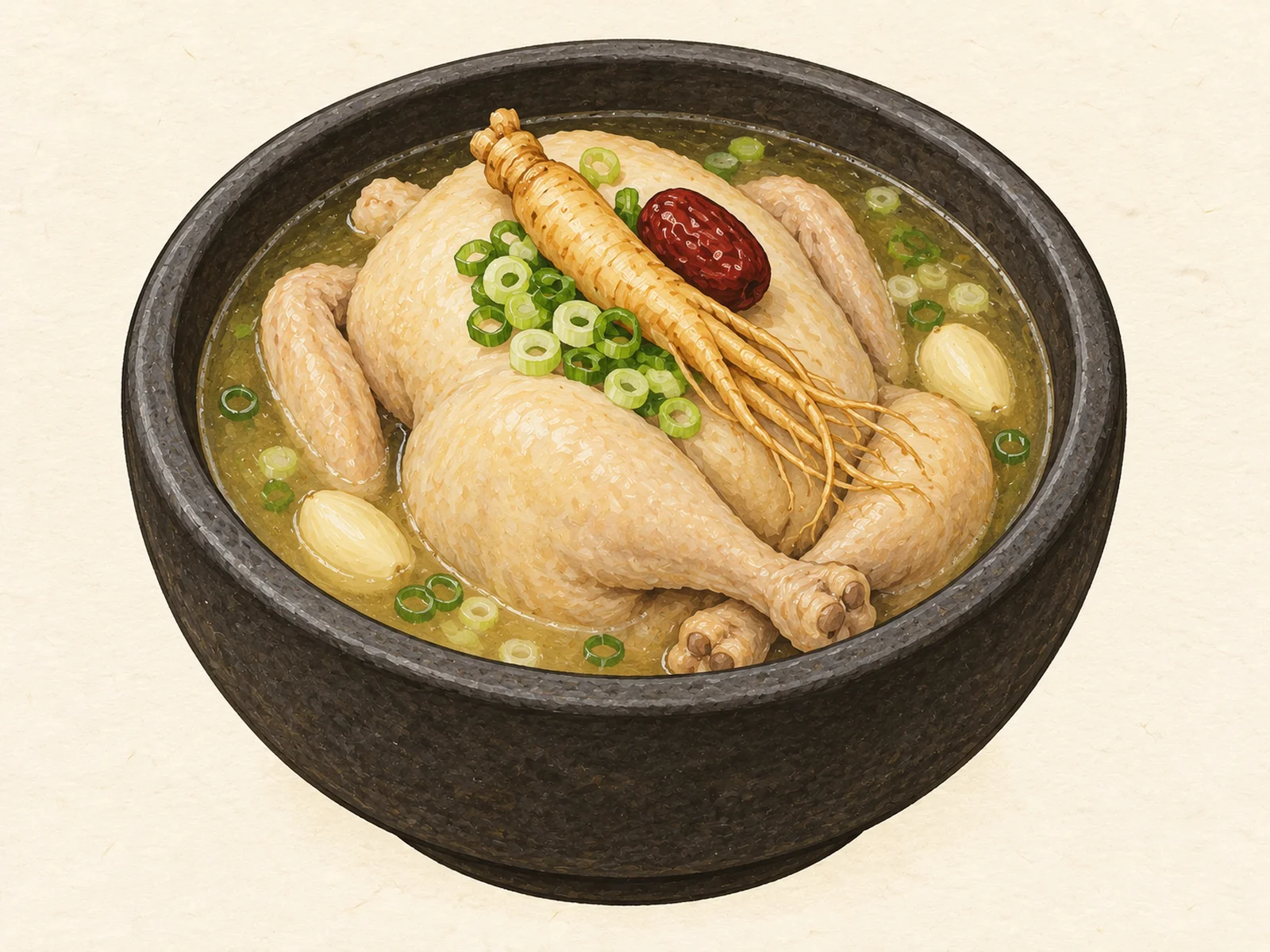
About This Dish
This samgyetang serves two and takes about 2 hours and 20 minutes, including 1 hour of soaking the rice. Two small chickens are filled with glutinous rice, fresh ginseng, jujubes and garlic, then simmered whole in water until the meat is tender and the rice inside is soft. The key is to leave room in each chicken for the rice to swell, and to cook until both the meat and the filling are done.
The National Folk Museum of Korea’s encyclopedia traces a chicken soup with white ginseng powder to a 1917 cookbook and notes that the dish was once called gyesamtang. According to the same encyclopedia, the name samgyetang spread after the 1960s. The encyclopedia dates its place as a typical meal for boknal, the hottest days of summer, to the 1980s and later.
Restaurants often serve one small chicken per person. This entry uses two small chickens, so each bowl holds one whole bird. For other Korean soups, see gamjatang (pork bone soup) and kimchi jjigae (kimchi stew).
Ingredients
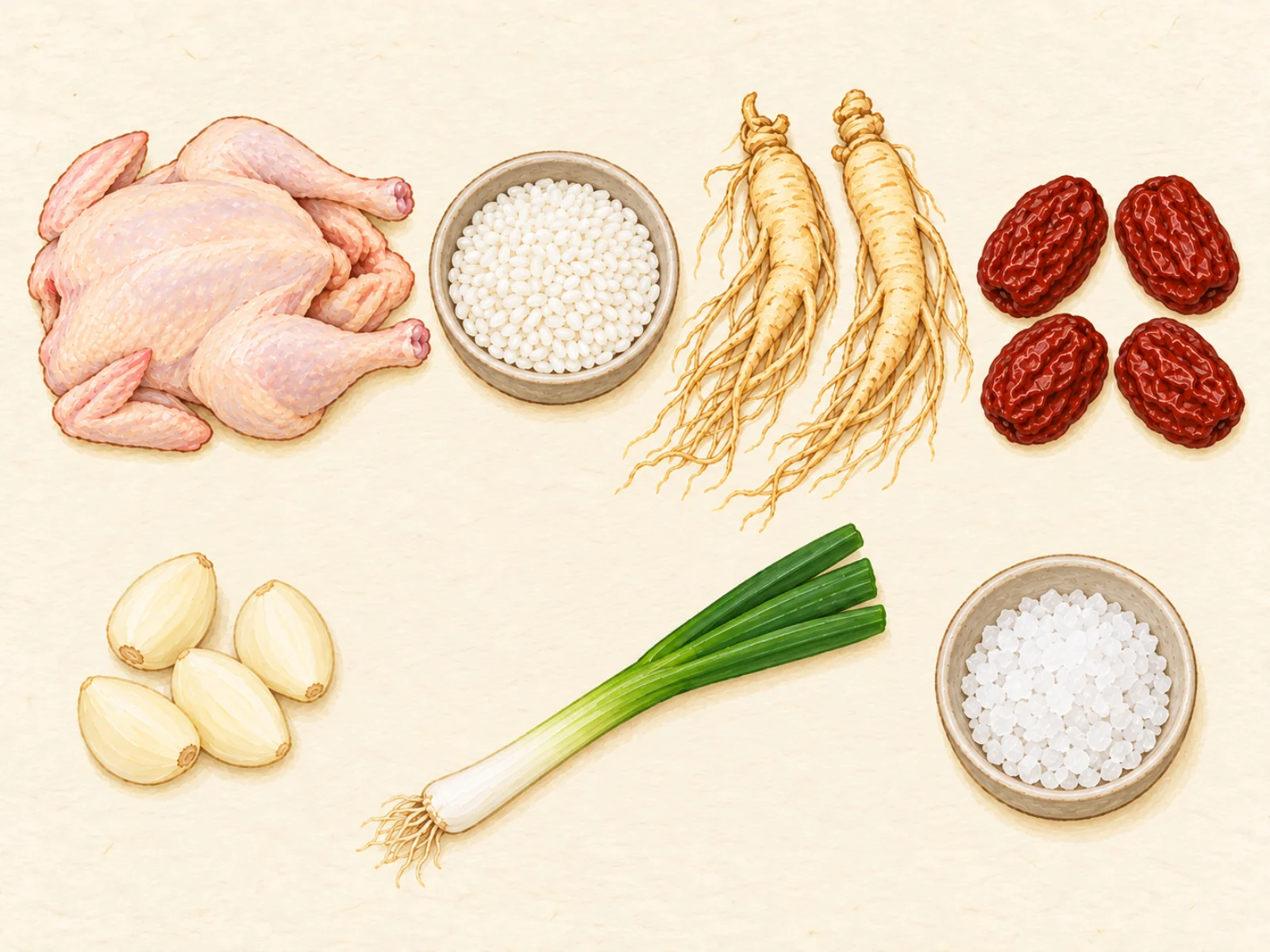
Scroll sideways to see all columns →
| # | Ingredients | Qty | Remarks |
|---|---|---|---|
| 01 | Small whole chickens (poussins or Cornish hens) | 2 ea, about 500 g (17.6 oz) each | |
| 02 | Glutinous rice (sweet rice) | About 70 g (2.5 oz) | Dry weight |
| 03 | Fresh ginseng (susam) | 2 roots | Scrubbed clean |
| 04 | Dried jujubes (daechu) | 4 ea | |
| 05 | Garlic cloves | 10 cloves | Peeled |
| 06 | Water | About 2 L (8 1/2 cups) | |
| 07 | Green onion | 1 stalk | 2/3 for the broth, 1/3 thinly sliced for the top |
| 08 | Salt | About 1/2 tbsp | Adjust to taste |
Equipment
- Large pot, at least 4 L (about 4 1/4 US qt), with a lid
- Kitchen scissors
- Bowl (for soaking the rice)
Instructions
Rinse the rice. Soak it in cold water for about 1 hour. Drain it.
Glutinous rice (sweet rice) About 70 g (2.5 oz)
Cut off the tail, wing tips and excess fat inside each chicken. Pat the cavity dry with paper towels.
Small whole chickens (poussins or Cornish hens) 2 ea, about 500 g (17.6 oz) each
Fill each chicken about three-quarters full with rice, 1 ginseng root, 1 jujube and 2 garlic cloves. Leave room for the rice to swell.
Fresh ginseng (susam) 2 roots · Dried jujubes (daechu) 2 ea · Garlic cloves 4 cloves
Cut a small slit in the skin of one leg. Push the other leg through the slit to close the cavity.
Put the chickens, water, most of the green onion and the remaining rice, jujubes and garlic in the pot. Cover the pot. Bring it to a boil over high heat.
Water About 2 L (8 1/2 cups) · Green onion 2/3 stalk · Dried jujubes (daechu) 2 ea · Garlic cloves 6 cloves
Skim off the foam. Cover the pot. Simmer over medium-low heat for about 50 minutes, until the legs move easily and the rice inside is soft.
Check that the meat and the rice filling are cooked through. Season the broth with salt. Serve each chicken in a bowl with broth. Top with the sliced green onion.
Salt About 1/2 tbsp · Green onion 1/3 stalk
Doneness Check
- The meat is cooked through and pulls easily from the bone (optional check: the thickest meat, away from the bone, and the center of the rice filling stay at or above 75°C (167°F) for at least 1 minute)
- The rice inside the chicken is soft and swollen, with no hard grains
- The broth is clear and covers the chickens
Variations
- Bangyetang (half-chicken version)
- It is recorded as a specimen reduced to half a chicken.
- Jeonbok samgyetang (abalone version)
- Abalone is added; the recipe checked for this entry also adds hwangtae (dried pollack) and mung beans.
- Deulkkae samgyetang (perilla seed version)
- Ground perilla seeds and glutinous rice flour are stirred into the broth to thicken it.
Similar Dishes
- Baeksuk (plain whole chicken soup)
- Baeksuk is a whole chicken boiled without ginseng; one recipe writer separates it from samgyetang by that missing root.
FAQ
How long should I soak the rice?
This entry soaks the glutinous rice in cold water for about 1 hour. Regular short-grain rice also works in some recipes.
When should I add salt?
This entry seasons the broth with salt at the end and adjusts it to taste. Some recipes add salt to the water at the start.
How do I store leftover samgyetang?
Take the rice out of the chicken and refrigerate the rice, chicken and broth separately in shallow containers within 2 hours after cooking (1 hour if the room is 32°C (90°F) or hotter), at 4°C (40°F) or below. Eat the rice within 24 hours after cooking and reheat it only once; eat the chicken and broth within 3–4 days. Reheat until all parts reach 74°C (165°F), and bring the broth to a rolling boil.
Sources
- Korean Bapsang — Samgyetang
- Maangchi — Samgyetang
- My Korean Kitchen — Samgyetang
- Beyond Kimchee — Samgyetang
- 10000recipe — Easy samgyetang (Korean)
- Wtable — Abalone samgyetang (Korean)
- Kim Jin-ok — Perilla seed samgyetang (Korean)
- National Folk Museum of Korea — Samgyetang (Korean)
- National Folk Museum of Korea webzine — Samgyetang (Korean)
- USDA — Chicken from farm to table
- USDA — Stuffing and food safety
- MFDS — Cooking meat safely (Korean)
- UK Food Standards Agency — Home food fact checker
- USDA — Leftovers and food safety
- FoodSafety.gov — Cold food storage chart
Compiled and reviewed by Nuri · Published