 K-Dogam
No. 016 · Tang
Dakbokkeumtang Recipe (Korean Spicy Braised Chicken)
닭볶음탕 · Dakbokkeumtang
Servings & Time
2 servings · Prep 20min · Cook 35min
About This Dish
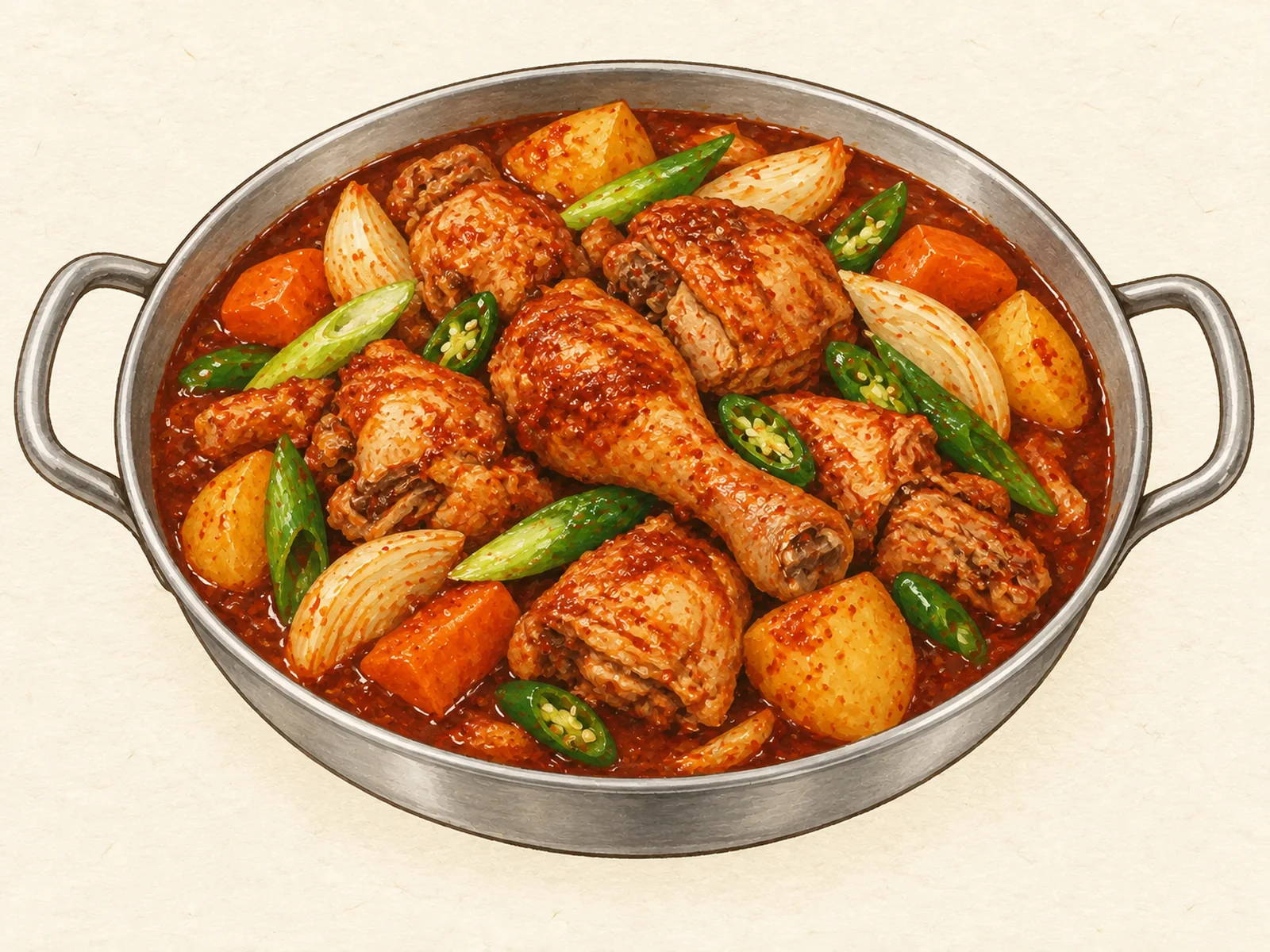
This dakbokkeumtang serves two and takes about 55 minutes. Bone-in chicken pieces simmer with potatoes, carrot and onion in a red sauce made from gochugaru (Korean chili flakes) and gochujang (Korean chili paste). The key is to cook the chicken covered first, then take off the lid so the sauce thickens around the potatoes.
Imwon simnyukji, a late Joseon encyclopedia of rural life, records a dish made with cut-up chicken, but this does not establish that it was the same dish as today’s dakbokkeumtang. Haedong jukji, a 1920s collection of verses on Korean customs, describes doritang, a chicken dish, as a Pyongyang specialty, and the 1936 edition of Joseon mussang sinsik yori jebeop, a Korean cookbook, records doritang as the Songdo (Kaesong) name for dakbokkeum, a chicken dish. Newspapers in the 1980s mention dakdoritang at restaurants near the Hongcheon River and Namhansanseong, a mountain fortress near Seoul.
The dish is also called dakdoritang. In 1992, the Ministry of Culture recommended the name dakbokkeumtang in its guidelines for food terms. The National Institute of Korean Language explains dori as a word from Japanese and recommends dakbokkeumtang instead. The same page mentions a view that reads dori as a native Korean word for a part of something, but the institute does not accept that view.
You can mix some of the red sauce into rice. For other Korean soups and stews, see samgyetang (ginseng chicken soup) and gamjatang (pork bone soup).
Ingredients
Scroll sideways to see all columns →
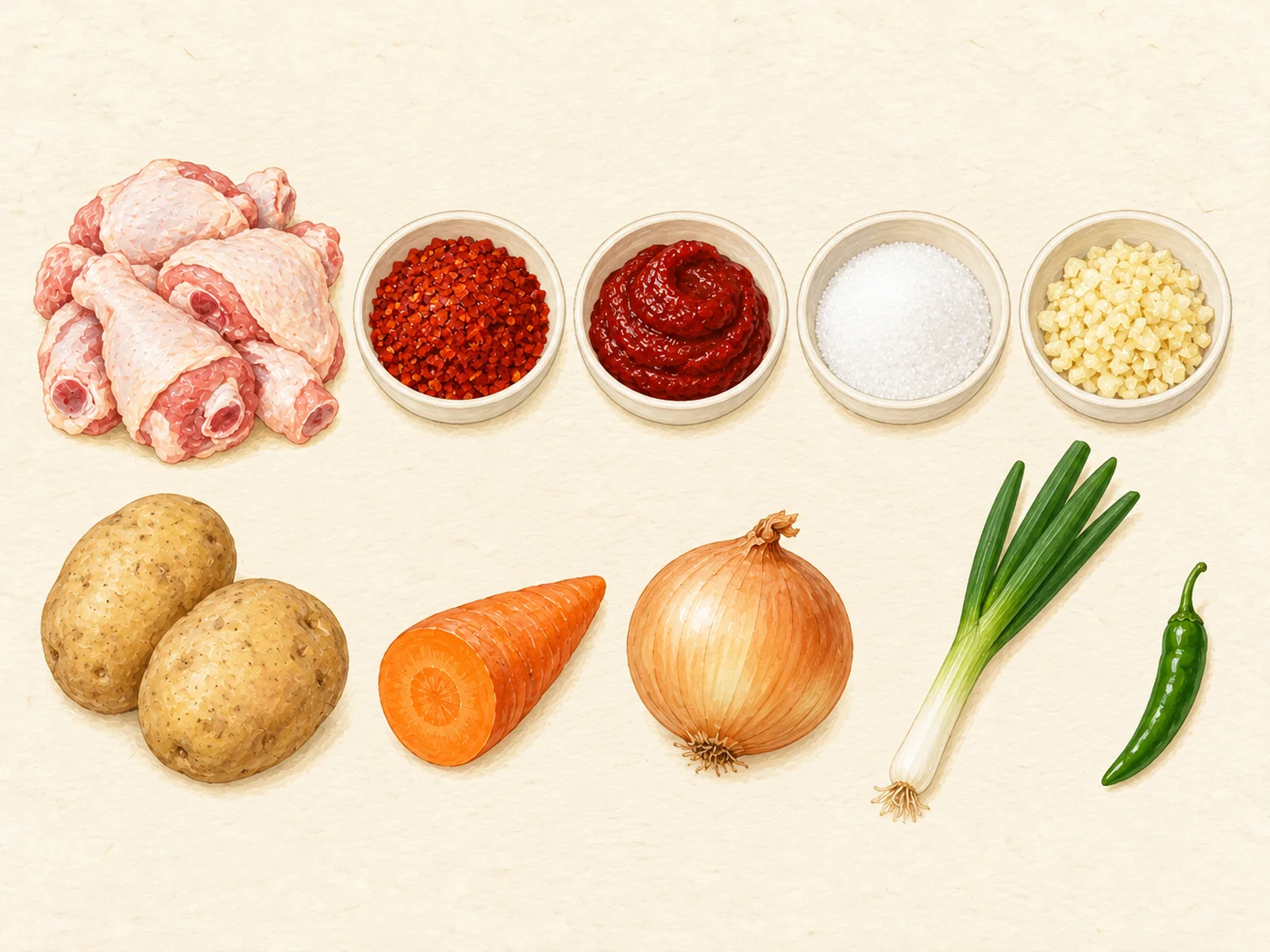
| # | Ingredients | Qty | Remarks |
|---|---|---|---|
| 01 | Bone-in chicken pieces | About 1 kg (35.3 oz) | One whole chicken cut into small pieces for braising |
| 02 | Gochugaru (Korean chili flakes) | About 3 tbsp | |
| 03 | Gochujang (Korean chili paste) | About 2 tbsp | |
| 04 | Soy sauce | About 3 tbsp | Regular cooking soy sauce, not soup soy sauce |
| 05 | Sugar | About 1 1/2 tbsp | |
| 06 | Minced garlic | About 1 tbsp | |
| 07 | Ground black pepper | A pinch | |
| 08 | Water | About 500 ml (2 1/8 cups) | |
| 09 | Potatoes, medium | 2 ea (about 300 g / 10.6 oz) | Use firm potatoes with no sprouts or green patches |
| 10 | Carrot | 1/2 ea | |
| 11 | Onion | 1 ea | |
| 12 | Green onion | 1 stalk | |
| 13 | Cheongyang chili (hot green chili) | 1 ea (optional) |
Equipment
- Wide pot, at least 3 L (about 3 1/4 US qt), with a lid
- Second pot (for blanching)
- Colander
- Kitchen scissors
- Small bowl
Instructions
In a small bowl, mix the gochugaru, gochujang, soy sauce, sugar, garlic and pepper.
Gochugaru (Korean chili flakes) About 3 tbsp · Gochujang (Korean chili paste) About 2 tbsp · Soy sauce About 3 tbsp · Sugar About 1 1/2 tbsp · Minced garlic About 1 tbsp · Ground black pepper A pinch
Cut each potato into 2 or 3 large chunks. Cut the carrot and onion into large pieces. Cut the green onion into 4 cm (about 1 5/8 in) lengths. Slice the chili diagonally, if used.
Potatoes, medium 2 ea (about 300 g / 10.6 oz) · Carrot 1/2 ea · Onion 1 ea · Green onion 1 stalk · Cheongyang chili (hot green chili) 1 ea (optional)
Cut off thick pieces of fat and skin from the chicken with scissors.
Bone-in chicken pieces About 1 kg (35.3 oz)
Put the chicken in boiling water for about 1 minute. Drain it in a colander and discard the water.
Put the chicken, water and sauce in the wide pot. Cover the pot. Bring it to a boil over high heat. Cook over medium heat for about 10 minutes.
Water About 500 ml (2 1/8 cups)
Add the potatoes and carrot. Cover the pot. Cook over medium heat for about 15 minutes.
Add the onion. Cook with the lid off for about 5 minutes, until a chopstick goes easily into the potatoes.
Add the green onion and, if used, the chili. Cook for about 2 minutes. Check that each piece of chicken is cooked through.
Doneness Check
- Each piece of chicken is cooked through and pulls easily from the bone (optional check: the thickest meat in each piece, away from the bone, stays at or above 75°C (167°F) for at least 1 minute; check several spots in large, irregular pieces; color alone does not show that chicken is done)
- A chopstick goes easily into the potatoes
- The sauce is thick enough to coat the chicken, and the bottom of the pot is not burned
Variations
- Ganjang dakbokkeumtang (soy sauce version)
- Soy sauce, sugar and oligosaccharide syrup replace the gochugaru and gochujang.
Similar Dishes
- Andong jjimdak (Andong braised chicken)
- It carries the name jjim (steamed dish), yet the encyclopedia records it keeping its distance from steam and braising in a large pan with soy-based seasoning.
- Dakgalbi (spicy stir-fried chicken)
- In the Chuncheon style compared here, marinated chicken is stir-fried in a wide pan with vegetables and tteok (rice cakes), not simmered in a pot.
FAQ
What chicken should I buy?
This entry uses about 1 kg (35.3 oz) of bone-in pieces cut from one whole chicken. Bone-in, skin-on thighs and drumsticks also work. Check the cooking time again if you change the cut.
How can I make it less spicy?
Use less gochugaru and leave out the chili. One recipe uses 2 to 3 tbsp of gochugaru for four servings and adjusts it to taste.
How do I store leftover dakbokkeumtang?
Divide the chicken, potatoes and sauce among shallow containers and refrigerate them within 2 hours after cooking (1 hour if the room is 32°C (90°F) or hotter), at 4°C (40°F) or below. Eat them within 3–4 days. Reheat until all parts reach 74°C (165°F), and bring the sauce to a rolling boil.
Is dakdoritang the same dish?
Yes. Dakdoritang is another name for the same dish. The National Institute of Korean Language recommends dakbokkeumtang as the standard name.
Sources
- Korean Bapsang — Dakdoritang
- My Korean Kitchen — Spicy Korean chicken stew
- Korean Bapsang — Jjimdak
- My Korean Kitchen — Dak galbi
- Wtable — Spicy dakbokkeumtang (Korean)
- Kim Jin-ok — Dakbokkeumtang (Korean)
- 10000recipe — Soy sauce dakbokkeumtang (Korean)
- National Institute of Korean Language — Dakdoritang (Korean)
- Encyclopedia of Korean Culture — Andong jjimdak (Korean)
- USDA — Chicken from farm to table
- USDA — Food thermometers
- USDA — Washing food
- MFDS — Cooking meat safely (Korean)
- Centre for Food Safety (Hong Kong) — Potatoes
- USDA — Leftovers and food safety
- FoodSafety.gov — Cold food storage chart
- Sempio — Gochujang ingredients
- Korean Traditional Knowledge Portal — Chicken dish in Imwon simnyukji, an encyclopedia of rural life (in Korean)
- Lee In-yeong, Jeong Hui-seon — Korean food culture in Haedong jukji (2019, in Korean)
- Dong-A Ilbo — Yun Deok-no on dakdoritang (2011, in Korean)
- Korean Traditional Knowledge Portal — Chicken dish in Joseon mussang sinsik yori jebeop, 1936 edition (in Korean)
- Chosun Ilbo — Hongcheon River fishing spots, 1984 (in Korean)
- Kyunghyang Shinmun — Namhansanseong, 1985 (in Korean)
- Hankyoreh — Food terminology guidelines, 1992 (in Korean)
Compiled and reviewed by Nuri · Published · Updated