 K-Dogam
No. 009 · Bap
Classic Gimbap Recipe with Ham and Egg (Kimbap)
김밥 · Gimbap
Servings & Time
2 servings · Prep 30min · Cook 20min
About This Dish
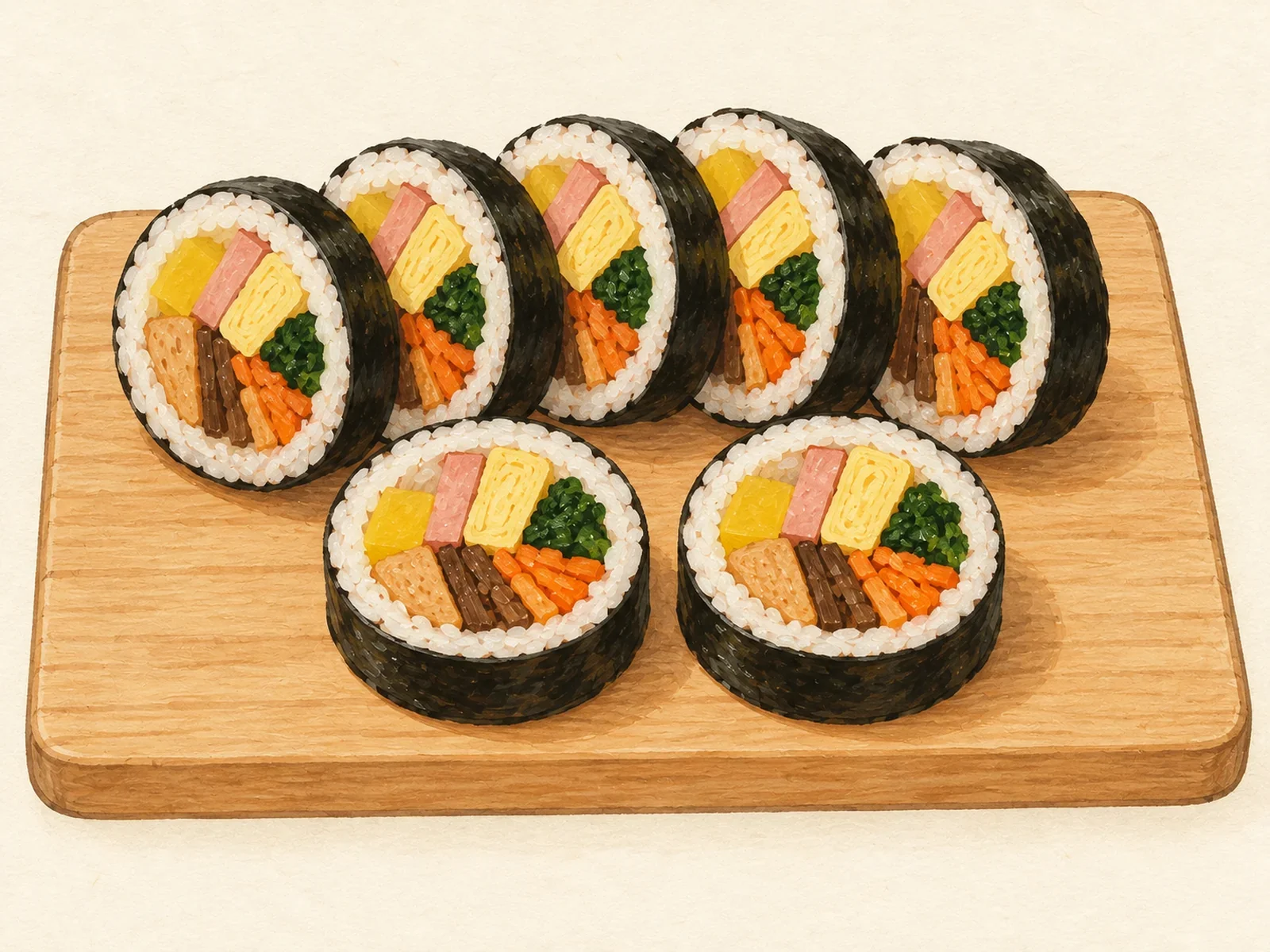
This classic gimbap makes two rolls for two people in about 50 minutes, starting from cooked rice. Warm rice seasoned with sesame oil and salt is spread on gim (dried seaweed), filled with seven fillings, rolled and sliced. The key is a thin, even layer of rice and dry fillings, so the roll stays tight.
Gimbap is rice and fillings rolled in gim. In Korea it is a standard dish at bunsikjip, snack shops that sell quick dishes such as gimbap, tteokbokki (spicy rice cakes) and ramyeon (Korean instant noodles). Bunsik once meant food made from flour, but today it covers this wider group of quick, casual dishes.
Late Joseon records of seasonal customs describe bokssam, rice wrapped in gim and eaten at the first full moon of the lunar year, and the name gimbap appears in a 1925 newspaper. Accounts differ on the origin of today’s filled rolls: one traces them to seaweed-wrapped sushi introduced from Japan during the colonial period and adapted in Korea, while another traces it to bokssam. Public sources also describe gimbap spreading further as a quick everyday meal in the 1990s, as specialist shops and franchises grew.
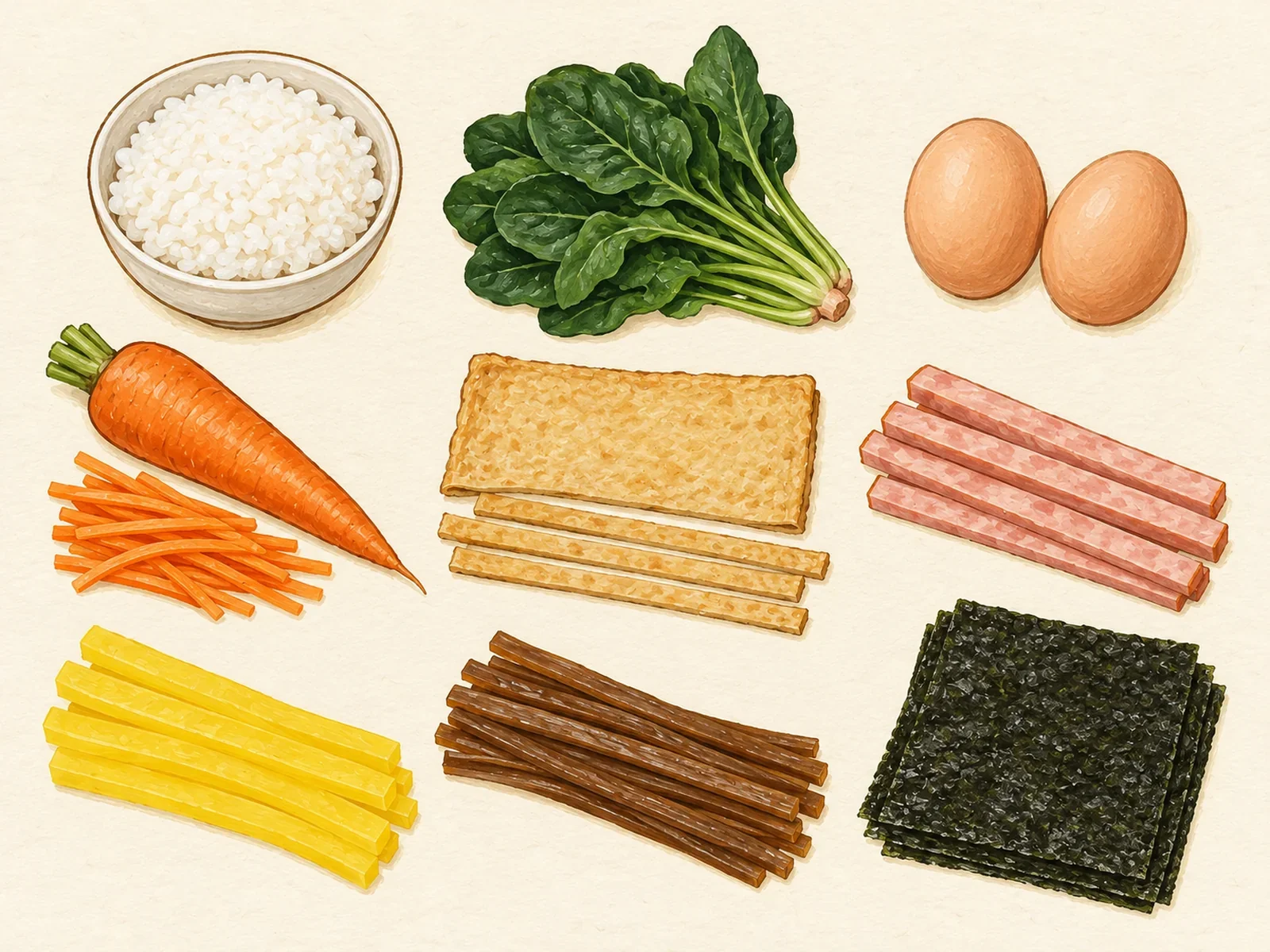
The fillings change from recipe to recipe. This entry uses spinach, egg, carrot, eomuk (Korean fish cake), ham, danmuji (Korean pickled radish) and seasoned burdock root. Ham, danmuji and burdock root are sold ready for gimbap at Korean grocery stores.
Ingredients
Scroll sideways to see all columns →
| # | Ingredients | Qty | Remarks |
|---|---|---|---|
| 01 | Cooked short-grain white rice | About 300 g (10.6 oz) | Warm. Cooking the rice is not included in the total of about 50 minutes |
| 02 | Salt | About 1/4 tsp + 3 pinches | Divided |
| 03 | Sesame oil | About 1 tbsp | Divided |
| 04 | Spinach | About 100 g (3.5 oz) | Raw weight |
| 05 | Eggs | 2 ea | |
| 06 | Cooking oil | About 3 tsp | Divided |
| 07 | Carrot | 1/2 ea (about 70 g / 2.5 oz) | Thin matchsticks |
| 08 | Eomuk (Korean fish cake), flat sheet | 1 sheet | Cut into strips about 1 cm (3/8 in) wide |
| 09 | Soy sauce | About 1 tsp | Regular cooking soy sauce |
| 10 | Sugar | About 1/2 tsp | |
| 11 | Water | About 1 tbsp | For the eomuk |
| 12 | Gimbap ham | 2 strips | Long strips about 1 cm (3/8 in) thick |
| 13 | Danmuji (Korean pickled radish) | 2 strips | Sold cut for gimbap |
| 14 | Seasoned burdock root strips | 2 strips | Sold cooked for gimbap. Alt: omit |
| 15 | Gim (dried seaweed sheets) for gimbap | 2 sheets |
Equipment
- Pot, 18–20 cm (about 7–8 in), for blanching
- Frying pan, 24–26 cm (about 9 1/2–10 1/4 in)
- Gimbap mat (bamboo rolling mat), optional
- Wide bowl (for the rice)
- Plates (for the fillings)
- Sharp knife and a clean damp cloth
Instructions
Put the warm rice in a wide bowl. Add the salt and sesame oil. Mix gently.
Cooked short-grain white rice About 300 g (10.6 oz) · Salt About 1/4 tsp · Sesame oil About 1/2 tbsp
Bring a pot of water to a boil. Blanch the washed spinach for about 30 seconds, until the leaves soften.
Spinach About 100 g (3.5 oz)
Rinse the spinach in cold water. Squeeze out the water. Mix in a pinch of salt and the sesame oil.
Salt A pinch · Sesame oil About 1/2 tsp
Beat the eggs with a pinch of salt.
Eggs 2 ea · Salt A pinch
Heat the pan over medium-low heat. Add oil. Pour in the eggs. Cook both sides until the egg is fully set.
Cooking oil About 1 tsp
Transfer the egg to a plate. Let it cool. Cut it into long strips about 1 cm (3/8 in) wide.
Increase the heat to medium. Add oil. Stir-fry the carrot with a pinch of salt for about 1 minute, until slightly soft. Transfer it to a plate.
Carrot 1/2 ea (about 70 g / 2.5 oz) · Cooking oil About 1 tsp · Salt A pinch
Add oil. Stir-fry the eomuk for about 30 seconds. Add the soy sauce, sugar and water.
Eomuk (Korean fish cake), flat sheet 1 sheet · Cooking oil About 1 tsp · Soy sauce About 1 tsp · Sugar About 1/2 tsp · Water About 1 tbsp
Cook the eomuk for about 2 minutes, until almost no liquid is left. Transfer it to a plate.
Cook the ham in the dry pan for about 1 minute. Turn it during cooking. Transfer it to a plate.
Gimbap ham 2 strips
Pat the danmuji and burdock root dry with paper towels.
Danmuji (Korean pickled radish) 2 strips · Seasoned burdock root strips 2 strips
Put a gim sheet on the mat or a clean work surface, shiny side down. Put a long side toward you.
Gim (dried seaweed sheets) for gimbap 1 sheet
Spread half of the rice thinly over the gim. Leave about 4 cm (1 1/2 in) empty at the far edge.
Put half of each filling in a line across the rice, near the edge closest to you.
Roll the gim away from you. Hold the fillings in place with your fingers. Press the roll evenly with the mat or your hands.
Wet the empty edge with a little water. Finish the roll. Put it seam side down.
Make the second roll with the remaining gim sheet, rice and fillings.
Gim (dried seaweed sheets) for gimbap 1 sheet
Brush the rolls and the knife with sesame oil. Cut the rolls into pieces about 1.5 cm (5/8 in) thick. Wipe the knife with the damp cloth when rice sticks to it.
Sesame oil About 1 tsp
Doneness Check
- The egg is fully set, with no liquid egg
- The spinach is squeezed dry, and the eomuk has almost no liquid left
- The cut roll has a thin, even layer of rice around the fillings
- The roll is firm, the seam stays closed, and the fillings stay in place when cut
Variations
- Chamchi gimbap (tuna gimbap)
- Some tuna gimbap recipes use tuna mixed with mayonnaise, with kkaennip (perilla leaves) alongside it.
- Kkoma gimbap (mini gimbap)
- The gim is cut into halves or quarters to roll small, thin gimbap.
- Chungmu gimbap
- This specimen travels apart from its seasoned squid and radish kimchi, with only rice inside the gim.
- Sogogi gimbap (beef gimbap)
- Seasoned, cooked beef replaces the ham as the main filling.
Similar Dishes
- Japanese sushi rolls
- Sushi rolls use rice seasoned with vinegar, while the rice in this gimbap is seasoned with sesame oil and salt.
FAQ
What goes in gimbap, and can I leave something out?
Common fillings are danmuji, egg, carrot, spinach, ham, eomuk and burdock root. You can leave out a filling you cannot find, such as the burdock root or eomuk. Cucumber can replace the spinach.
Why does my gimbap fall apart?
Too much rice or filling, wet fillings, or a loose roll can make it open or break. Spread the rice thinly, pat the fillings dry, and press the roll firmly. Use a sharp knife brushed with sesame oil.
How long does gimbap keep, and why does the rice get hard?
Refrigerate leftovers within 2 hours (1 hour at 32°C (90°F) or above) at 4°C (40°F) or below, and eat them within 24 hours of cooking the rice. Reheat them once, until all parts reach 74°C (165°F). Cold rice gets firm because its starch changes during chilling, a process called retrogradation.
Are gimbap and kimbap different dishes?
No. They are two spellings of the same Korean dish, 김밥. Gimbap follows the Revised Romanization of Korean, and kimbap is a common alternative spelling.
Sources
- Maangchi — Gimbap
- Korean Bapsang — Kimbap
- My Korean Kitchen — Easy kimbap
- Serious Eats — Kimbap
- My Korean Kitchen — Tuna kimbap
- 10000recipe — Gimbap (Korean)
- Juneunsarang — Homemade gimbap (Korean)
- Semie Kitchen — How to make gimbap (Korean)
- Encyclopedia of Korean Culture — Gimbap (Korean)
- Korea.net — Street snacks (bunsik)
- Korea Tourism Organization — Chungmu gimbap
- MFDS — Safe gimbap preparation (Korean)
- UK Food Standards Agency — Home food fact checker
- Singapore Food Agency — Food handler's handbook (PDF)
- USDA — Hams and food safety
- Chakraborty et al. — Starch retrogradation (2023)
- Sempio — Jin soy sauce ingredients
- Moguchon — Gimbap ham allergen information (Korean)
- Samjin — Flat fish cake product information (Korean)
- FDA — Egg safety
- USDA — Leftovers and food safety
- National Folk Museum of Korea — Gimbap (in Korean)
- Rural Development Administration — Gimbap, 2024 (in Korean)
- Korea Heritage Service — Gimbap column (in Korean)
Compiled and reviewed by Nuri · Published · Updated